
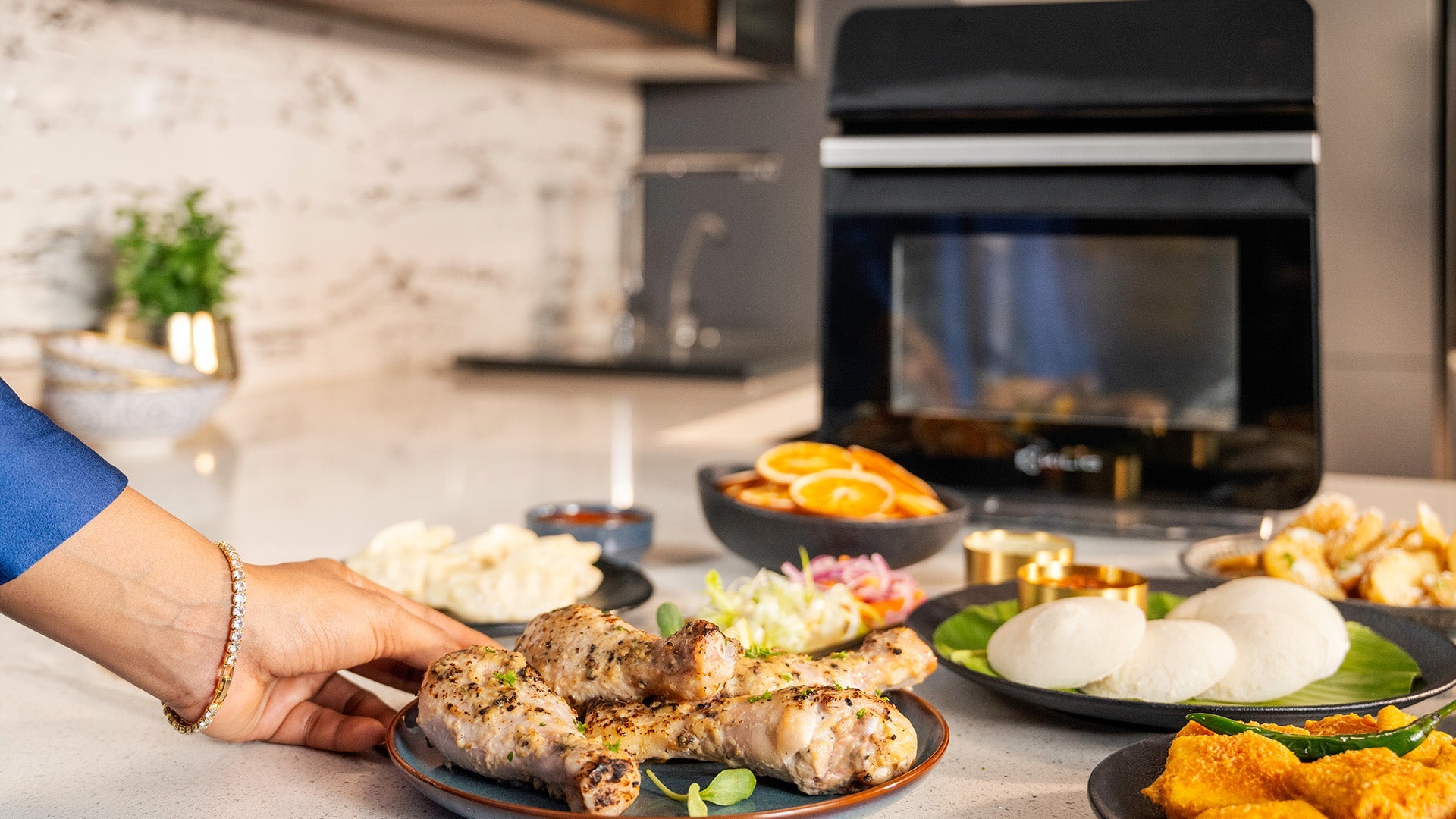
The air fryer earns its reputation. It produces a genuinely crispy exterior on samosas, French fries, paneer tikka, and chicken wings using very little oil. Most people who own one are satisfied with the results. Fewer people understand the mechanism behind those results.
An air fryer is not just a small oven with a different name. The way it moves heat around food is fundamentally different from a standard oven, and that difference is precisely what creates crispness rather than dry, baked texture.
Understanding how an air fryer works makes you a better user of it. You'll know why a crowded basket ruins crispness, why preheating matters, and why the crust on your food involves the same chemical reaction as deep frying, achieved through air rather than hot fat. This guide breaks down the full mechanism, the key components, how the machine produces crunch without oil, and how different models are designed for different kitchen needs.
What Is an Air Fryer?
An air fryer is a compact countertop appliance with a heating element and a high-speed fan. The science of how an air fryer works is based on the Maillard reaction. The fan drives hot air in rapid, continuous circulation around food inside a sealed chamber, reaching temperatures up to 200°C. This concentrated airflow cooks food and produces the same browning and crispiness as deep frying — without submerging the food in oil.
How Does an Air Fryer Work? Step-by-Step
Step 1: The heating element activates
The appliance powers an electric heating element that converts electrical energy into heat. Most models heat only from the top. The Kilig Nexa Core runs dual 1800W elements from both top and bottom, which heat the chamber faster and distribute heat more evenly across the full basket depth.
Step 2: The fan drives hot air at high speed
A high-speed fan sits above or behind the heating element. It pushes heated air in a rapid circular path through the sealed cooking chamber. This fan runs continuously through the cook cycle. It is what makes an air fryer heat faster than a conventional oven and circulate more intensely than a standard convection bake.
Step 3: Hot air circulates around the food from all directions
The circulating air does not come from one direction. It wraps around food, constantly transferring heat to all surfaces exposed. One of the key advantages of air frying over standard baking is this multi-directional, high-velocity heat transfer.
Step 4: The perforated basket allows airflow from below
The mesh or perforated basket lets hot air reach the underside of food. This creates crispness on the bottom without requiring the food to sit in fat. Overcrowding the basket blocks this airflow path, which is why a single layer always produces better results than a stacked one.
Step 5: The Maillard reaction creates the crust
When the food's surface exceeds 140°C, amino acids and reducing sugars react to produce a brown colour and a crispy texture. This is the Maillard reaction — the same process responsible for the crust on deep-fried food. Air frying reaches this threshold through heat carried by moving air, not hot oil. The result is the crunch you can hear.
Step 6: The drip tray separates the fat
Fat that renders from food during cooking drips below the basket into a collection tray. The food does not re-absorb this fat. This process is one reason air-fried food contains significantly less fat per serving than deep-fried equivalents.
Key Parts of an Air Fryer and Their Function
How an air fryer works depends largely on the following important parts of the air fryer:
1. Heating element
The electric resistance coil converts power to heat. Dual-element models run heating from both above and below the basket, producing a more even temperature across the full cooking volume compared to single top-element designs.
2. Fan
The fan separates air frying from oven baking. It drives hot air at high speed directly at food surfaces. Without it, the heating element would simply warm a static volume of air, producing slow, uneven results — closer to a standard oven than to the sharpness and crispness air frying is known for.
3. Basket / tray
The basket holds food, and its perforated design allows airflow through from every direction. Basket material has real consequences. Borosilicate glass is toxin-free and lets you monitor the cook in real time. PTFE-based non-stick coatings can degrade if scratched at high temperatures, which is why coating-free or glass options are preferred by health-aware cooks.
4. Temperature control
The thermostat regulates heat output across the cook cycle. Most models cover a range of 80°C to 200°C. Advanced models like the Kilig Nexa SteamX extend the temperature range down to 30°C for dehydration and run a dedicated steam mode at 100°C, adding cooking techniques that no standard air fryer can replicate.
5. Drip tray
The tray below the basket catches fat and liquid rendered during cooking. Regular cleaning of this component prevents smoke, off-flavours, and residue transfer to the next cook cycle.
How Does an Air Fryer Work Without Oil?
The assumption in this question is that oil creates crunch. It does not. What oil does in deep frying is transfer heat to food surfaces efficiently and create a medium for the Maillard reaction. Air frying replaces both functions.
At high fan speeds, rapidly moving hot air transfers enough heat to food surfaces to trigger the Maillard reaction above 140°C. The crust forms through the same chemistry, with air as the medium instead of fat. This is why air frying uses less oil than deep frying and still produces comparable texture. A light oil spray is optional. It improves browning on marinated meats and battered foods.
Air Fryer vs Deep Fryer vs Oven: How They Work Differently
The cooking mechanism behind each appliance produces very different results:
| Cooking method | Heat source | Oil required | Preheat time | Texture result |
|---|---|---|---|---|
| Air fryer | Electric element + high-speed fan | Minimal to none | 2–3 minutes | Crispy exterior, moist interior |
| Deep fryer | Hot oil bath at high temperature | 500 ml – 1 L per batch | 5–10 minutes | Crispy exterior, moist interior |
| Conventional oven | Convection heat | 1–2 tbsp | 10–15 minutes | Drier exterior, soft interior |
5 Expert Tips for Better Air Frying Results
Tip 1: Preheat for 3 minutes
A cold chamber produces uneven cooking in the first 1 to 2 minutes. Preheating means food hits a fully ready environment from the moment it goes in.
Tip 2: Use a single layer in the basket
Stacking food blocks the airflow that does all the work. One layer crisps. Two layers steam. This is the single most common reason for soft air fryer results.
Tip 3: Shake or flip food halfway
The side resting directly on the basket gets less direct airflow. A flip or shake at the midpoint gives even browning on all surfaces.
Tip 4: Use a light oil spray for marinated or battered foods
A 2-second spray before cooking helps the surface brown faster without adding significant fat to the final dish.
Tip 5: Match temperature to food type
Fries and starchy snacks crisp best at 200°C. Fish and delicate proteins do well at 160–175°C. Dehydration runs at 30–80°C for slow drying without cooking.
Choosing the Right Air Fryer for Your Home
The difference between models isn't just capacity. Each one is built around a specific kind of kitchen and a specific set of cooking habits.
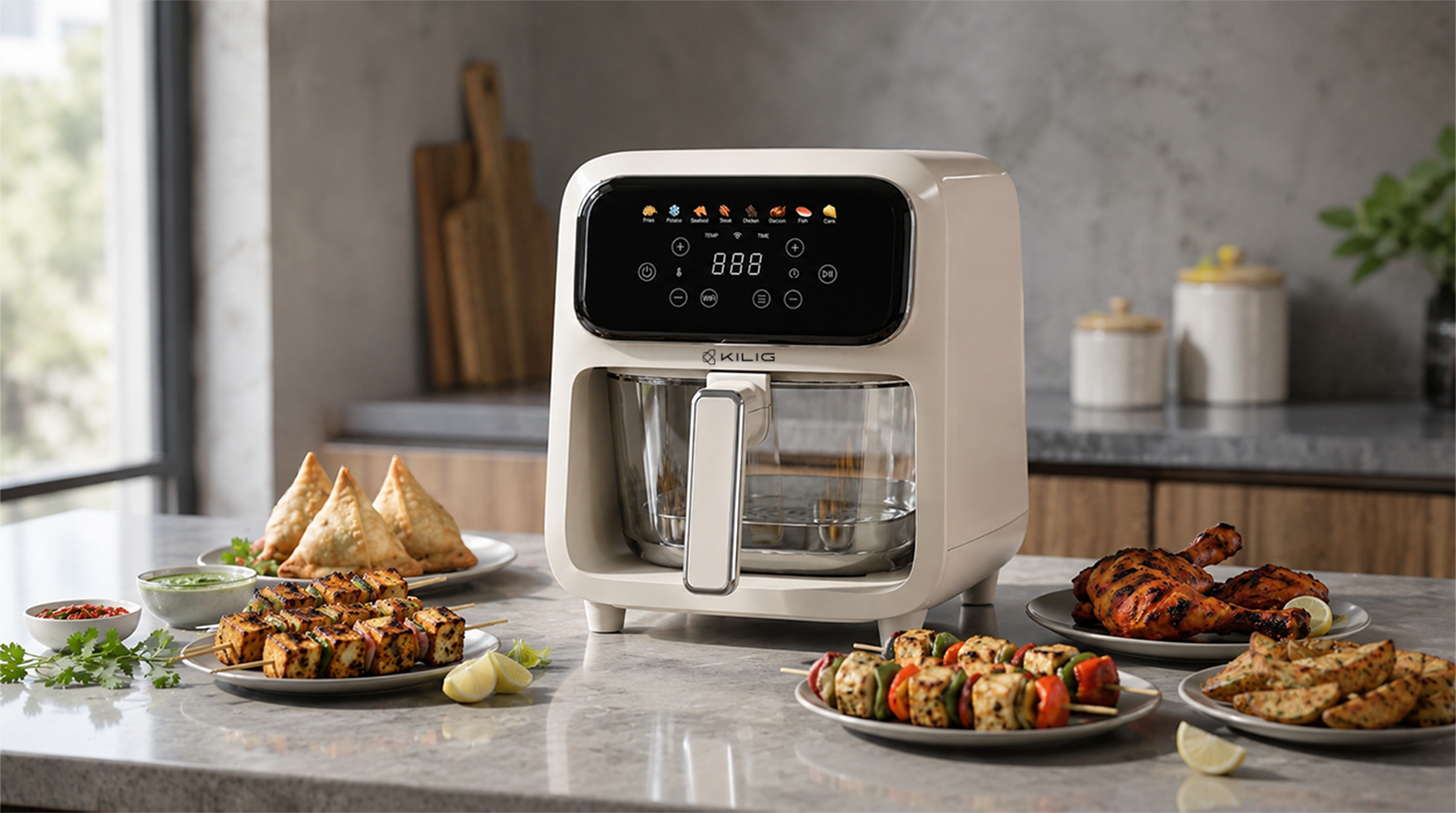
If you cook for one to three people and want precision without added complexity, the Kilig Nexa Core 4L is the natural fit. Its borosilicate glass basket is 100% free of PTFE, PFAS, and PFOA — so the same vessel you cook in is the one you serve from. Dual 1800W heating from both top and bottom removes uneven spots without any flipping. Eight Indian and global presets cover the dishes most Indian households cook daily, and StepChef™ handles multi-stage recipes automatically through the app.
For households of 4–6 with varied cooking needs, the Kilig Nexa Edge 12L replaces several appliances in one unit. It comes with six cooking modes — Air Fry, Grill, Bake, Rotisserie, Roast, and Dehydrate — and covers everything from a weeknight dinner to weekend hosting. Multi-rack simultaneous cooking means a full meal can come out of a single machine, with twelve chef-curated Indian and global presets and full app control throughout.
The Kilig Nexa SteamX 10.5L is for kitchens that cook beyond crisping. A built-in 1150 ml steam tank works alongside the air fryer to lock moisture into food before the hot air sets the crust. That combination is what koftas, dhokla, momos, and stuffed parathas actually need. Four cooking modes, nine presets, app-controlled.
The Kilig Iris Plus solves a different problem altogether. Two separate toxin-free glass containers (4L and 1.5L) sit in one appliance, so two entirely different dishes can cook at the same time with no shared temperature, timing, or flavour. It has 1500W, five cooking modes, and no app dependency — a practical pick for households that cook multiple items in every sitting.
Conclusion
Knowing how an air fryer works changes how you use it. The machine is built on a single principle: move hot air fast enough, in a small enough space, and you replicate what a vat of oil does for food texture — without the fat, the mess, or the smoke. Bonus point: no oil required at any point in the chain.
Frequently Asked Questions
How does an air fryer cook food without oil?
A high-speed fan drives hot air around food at temperatures up to 200°C. When the food surface exceeds 140°C, the Maillard reaction produces the same golden crust you get from deep frying. Oil is not required for this reaction to occur. Air frying reduces fat absorption by up to 70–80% compared to deep frying, while producing a comparable texture.
What is the science behind air frying?
Air frying is forced convection cooking in a compact chamber. A heating element warms the air, and a fan distributes it at high speed around the food; the result produces browning and crispness. The compact chamber and high fan speed create far more concentrated heat transfer than a standard convection oven operating across a much larger space.
Is an air fryer the same as a convection oven?
No, they are not. Both use a fan to distribute hot air, but an air fryer operates in a much smaller chamber, producing higher air velocity relative to the food. This intense airflow produces crispness in a quicker and more penetrating manner than a convection oven. The ratio of air volume to food surface area in an air fryer is far greater than that of a convection oven; that's where the better crust comes from.
Does an air fryer use radiation to cook?
No. An air fryer is a convection-only appliance. An electric element converts power to heat, and a fan carries that heat to food through air movement. There is no microwave radiation and no electromagnetic interaction with food molecules. This is the same physical mechanism as a fan oven or a hair dryer.
How long does it take an air fryer to heat up?
Most air fryers reach operating temperature in 2 to 3 minutes, compared to 10 to 15 minutes for a conventional oven. The difference is chamber volume; a smaller space heats to temperature faster. The Kilig Nexa Core is ready to cook in under 3 minutes from cold, preheating in exactly 2 minutes.
Share this product
WhatsApp Facebook X (Twitter) Telegram6 Easy Steps to Wash Your Air Fryer Properly
Meet StepChef™: The First Automated Multi-Stage Air Fryer Cooking Technology